

To what extent do you agree that “all things are numbers”?
A free, examiner-graded breakdown of TOK Title 5 for May 2026 — full outline, claim & counter-claim structure, two AOKs (The Arts + Human Sciences), and a complete sample answer. Written by IB examiners at Sev7n.
Theory of Knowledge · May 2026 · Title 5
The full outline & sample answer
A complete examiner-graded breakdown — interpretation, claims in Human Sciences, counter-claims in The Arts, comparative analysis, and a working sample essay.
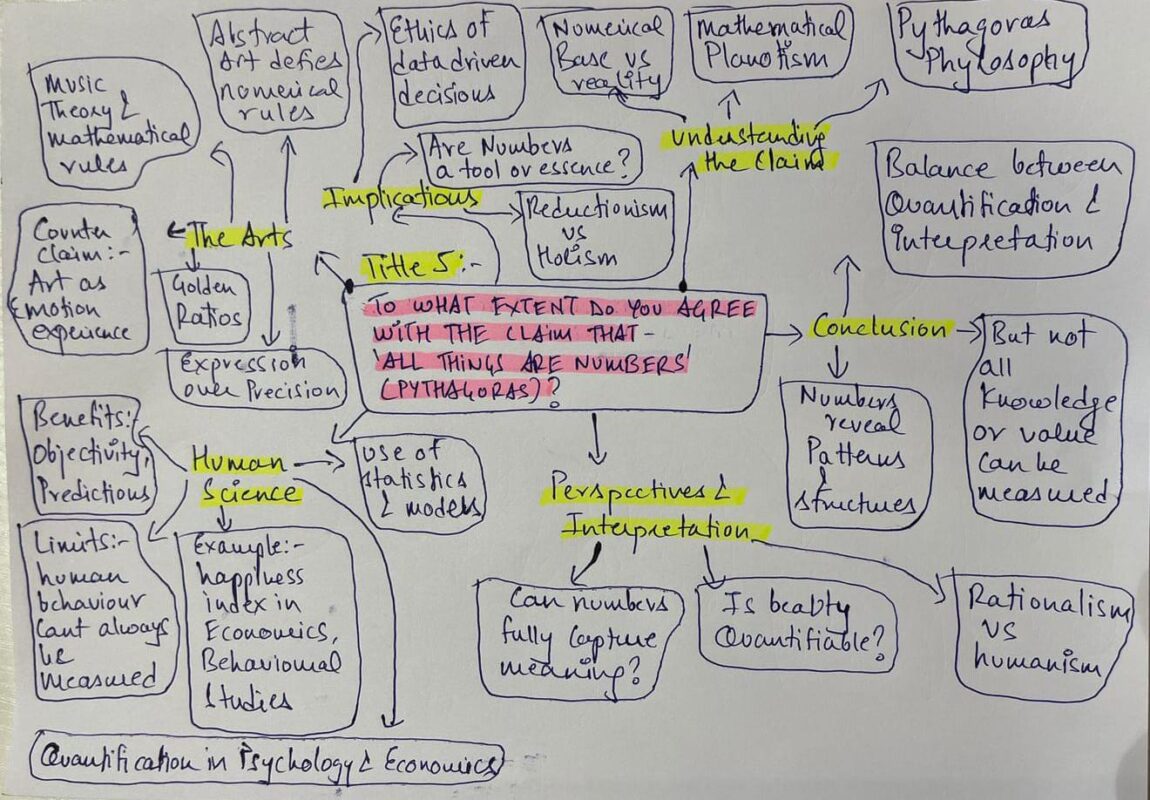
This title challenges students to explore the philosophical notion that reality can be reduced to numbers. Rooted in Pythagorean thought, it raises deep questions about the quantification of knowledge. While numbers are undeniably powerful in describing patterns and relationships, can they capture the richness of human experience or artistic expression?
In areas like the human sciences, data and statistics are central — but they may fall short in accounting for identity, emotion, or meaning. In the arts, structure and symmetry often involve numbers, yet the emotional or cultural significance of art goes beyond measurable elements. This essay invites a nuanced exploration of the boundaries between abstraction and lived reality across these two AOKs.
Table of Contents
1. Introduction
Begin by unpacking the key terms of the prompt. A strong introduction shows the examiner you are not treating the title as a slogan — you are interrogating it.
- “All things are numbers” — the Pythagorean view that reality and knowledge are ultimately reducible to quantitative structure: number, measurement, ratio, pattern.
- “Pythagoras” — the ancient tradition asserting that order, harmony, and mathematical relations underlie all phenomena.
- “Extent” — the degree to which the claim holds; not a yes/no question but a calibration.
- Reductionism vs. interpretation — when does numerical analysis illuminate, and when does it distort?
Interpretation of the claim
- Is reality fundamentally quantifiable, or only partially so?
- What does it mean for knowledge to be “captured” by numbers — explained, predicted, or merely described?
- Connections to ToK concepts: reductionism, symbolism, objectivity vs. subjectivity.
Chosen Areas of Knowledge: Human Sciences and The Arts.
Position stated: numerical frameworks illuminate many aspects of knowledge — particularly
in the human sciences — but not all knowledge can be reduced to numbers. The arts demonstrate where
quantification reaches its limit.
Stuck on framing your introduction?
Get a working draft in 60 minutes with an IB examiner — no waiting list.
2. Area of Knowledge 1 — Human Sciences (Claims)
Claim 1 — Quantification of social networks and predictive models
Graph-theoretic measures in anthropology and sociology map social networks in small-scale societies — for example, kinship networks among the Aka or Hadza, where surveys combined with mathematical network models predict the diffusion of ideas, behaviours, or disease. Measurements like degree centrality and betweenness produce predictions otherwise inaccessible. Knowledge about influence, relationships and spread emerges directly from numerical structure.
Claim 2 — Psychometrics and standardised testing
Modern psychometric work — for instance, the Big Five personality traits in cross-cultural psychology — uses item response theory and statistical scaling to quantify personality and correlate it with life outcomes, health, and job performance. Numbers allow human sciences to generalise, compare, and predict across populations. Yet this dependence on numbers also shapes what counts as knowledge: which traits are measured, which populations are studied, what counts as “valid”.
Implication: in the human sciences, numbers are not just descriptive — they are productive. They generate knowledge that would not exist without them. But they also impose the boundaries of what can be known.
3. Area of Knowledge 2 — The Arts (Counter-claims)
Counter-claim 1 — Aesthetic experience beyond quantification
Consider John Cage’s 4′33″, in which the performer plays nothing for four minutes and thirty-three seconds. The “content” is almost entirely unmeasurable — the duration is fixed, but the piece’s power lies in the listener’s interpretation, the ambient sounds of the room, and the emotional state of the audience. Counting silences misses what makes the work powerful. Some artistic knowledge resists numerical encapsulation entirely.
Counter-claim 2 — Artistic meaning tied to cultural symbolism
Aboriginal dot paintings often contain striking numeric patterns — dots, spacing, geometric repetition. But much of the meaning is symbolic, tied to Dreamtime stories that cannot be grasped through counting or geometric analysis alone. The numeric pattern supports the form, but the meaning depends on cultural context, oral tradition, and symbolism. Numbers may be necessary, but they are nowhere near sufficient.
“Numbers can describe the structure of a Van Gogh painting — the brush stroke count, the pigment ratio. They cannot describe why it makes us cry.”
Examiner’s Note · Shailey Valecha · IB Examiner
Don’t argue against Pythagoras. Calibrate him.
“The weakest essays on this title turn it into a yes/no debate. The strongest ones treat ‘extent’ as the real question — agreeing that numbers do enormous work in the human sciences, but showing precisely where they stop working in the arts. The mark scheme rewards calibration, not crusades.”
4. Comparative Analysis
- How human sciences use numbers to predict and generalise vs. the arts using numbers as scaffolding rather than substance.
- Where numbers are a lens (revealing patterns) vs. where they become a limit (excluding what can’t be measured).
- What is lost when subjective realities — meaning, identity, beauty — are reduced to numerical terms.
- When does numerical analysis serve truth, and when does it distort it through false precision?
The Human Sciences embrace numbers as a method — they extend the reach of inquiry, even as they constrain which questions can be asked. The Arts, by contrast, treat numerical structure as a means to a non-numerical end: numbers serve meaning, not the other way around. Pythagoras’s claim is therefore a partial truth — powerful where measurement is the point, weaker where experience is.
5. Essay Flow — Suggested Paragraph Structure
- Introduction and interpretation of the claim.
- Claim — Human Sciences (Big Data and behavioural economics).
- Claim — Human Sciences (psychometrics and predictive modelling).
- Counter-claim — The Arts (Cage’s 4′33″ and aesthetic experience).
- Counter-claim — The Arts (Aboriginal dot painting and cultural symbolism).
- Synthesis — interpretive vs. measurable knowledge.
- Conclusion.
6. Conclusion
To a significant extent, Pythagoras is right — the human sciences would lose enormous explanatory power without numbers. But the arts demonstrate that numerical reduction is not universal. Some kinds of knowledge — emotional, cultural, symbolic — exist precisely because they exceed what can be counted.
Final stance: not all knowledge is numerical — and that is its strength. Numbers are one of the most powerful tools we have. But they are a tool, not the territory. The mature knower uses numbers where they reveal, and steps back where they would distort.

7. Bibliography
- Christakis, N. A., & Fowler, J. H. (2009). Connected: The Surprising Power of Our Social Networks. Little, Brown.
- McCrae, R. R., & Costa, P. T. (2008). The Five-Factor Theory of Personality. Handbook of Personality.
- Cage, J. (1961). Silence: Lectures and Writings. Wesleyan University Press.
- Morphy, H. (1998). Aboriginal Art. Phaidon Press.
- Russell, B. (1945). A History of Western Philosophy (chapters on Pythagoras). Simon & Schuster.
More from the Sev7n archive
TOK Essay Examples — read how a working argument is built
Twelve full TOK essays, examiner-graded and dissected. Read them, borrow the method — not the words.
Pick your TOK crisis.
Four kinds of students book this session. Find yourself below — same product, different framing.
Your TOK essay, rescued in 60 minutes.
Bring your draft — or a panicking half-plan. An examiner will diagnose your argument and fix AOK linking.
Rescue my essay →Don’t submit until an examiner has seen it.
60 minutes with an IB examiner. The gap between a 6 and an 8 is usually one conversation.
Reserve my slot →Sit with the examiner. Fix the essay.
Structure. AOK depth. Counter-claims. Conclusion force. Leave with a mark-scheme-ready draft.
Pay & book now →Stop guessing what examiners want.
An IB examiner reads your draft, pinpoints mark-loss, and rebuilds your argument with you. Live.
Book my review →All four sessions are the same product — ₹2,999 · 60 min · 1:1 with an IB examiner. The card just helps you frame your need.
Your TOK Grade · Handled
Reading an outline is one thing. Writing yours is another.
Book a free 20-minute consult with an IB examiner. We’ll review your prescribed title, sketch your argument structure, and tell you exactly what to do next.
Book my free consult →