Is the power of knowledge determined by the way it is conveyed?
A free, examiner-graded breakdown of TOK Title 3 for May 2026 — full outline, claim & counter-claim structure, two AOKs (Mathematics + The Arts), and a complete sample answer. Written by IB examiners at Sev7n.
Theory of Knowledge · May 2026 · Title 3
The full outline & sample answer
A complete examiner-graded breakdown — interpretation, claims in Mathematics, counter-claims in The Arts, comparative analysis, and a working sample essay.
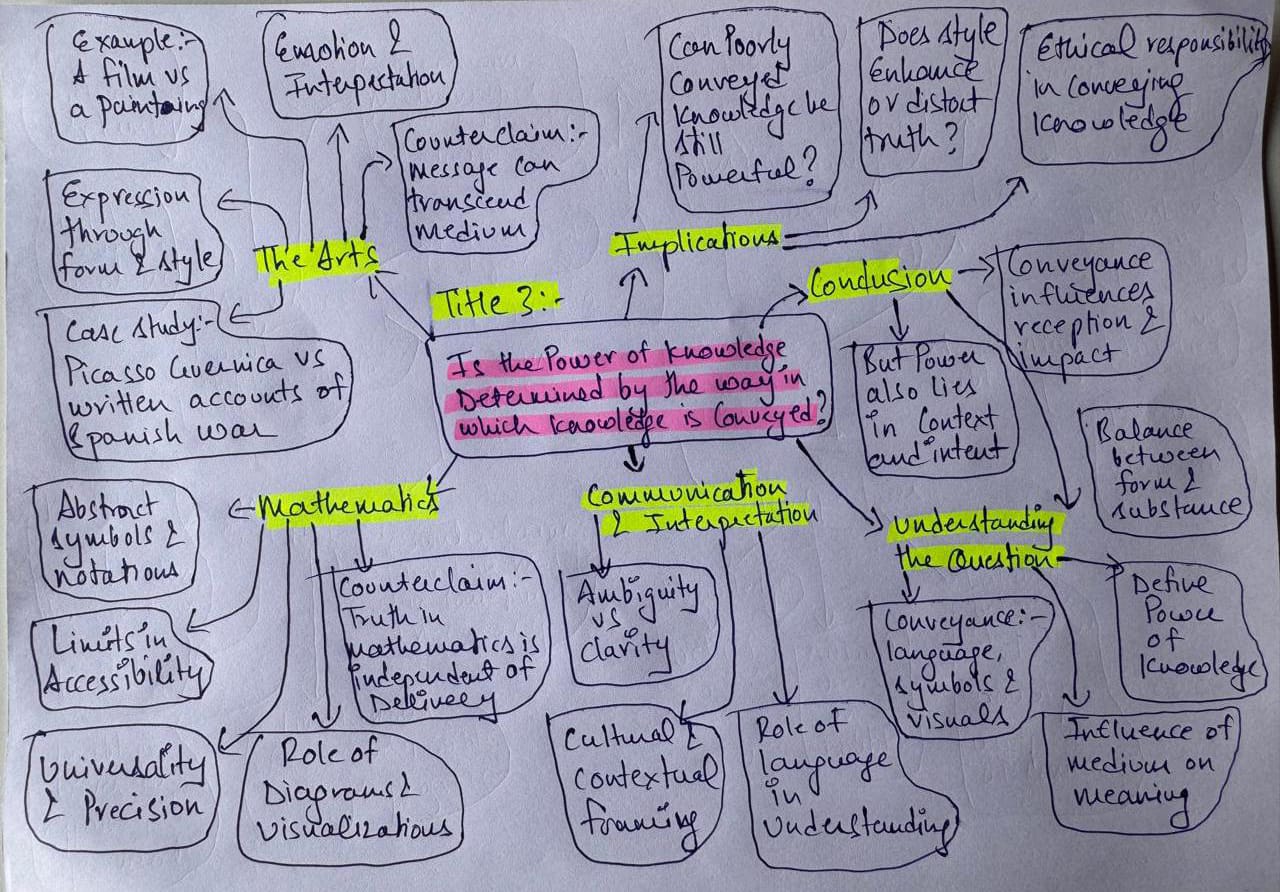
This title explores whether the influence and impact of knowledge depend on how it is delivered. In mathematics, knowledge is conveyed through abstract symbols and rigorous proofs — a system designed for precision and universality. In another area of knowledge — perhaps the arts or human sciences — communication may rely more on narrative, emotion, or aesthetics.
The question asks whether form (the way knowledge is communicated) plays a role in how it is received, trusted, or applied. Students should examine how different AOKs treat the conveyance of knowledge and whether clarity, elegance, or emotional resonance increases knowledge’s effectiveness. Importantly, this title also raises questions about the interaction between substance and style: is powerful knowledge that which is simply correct, or that which persuades and resonates across contexts?
Table of Contents
1. Introduction
Begin by unpacking the key terms of the prompt. A strong introduction shows the examiner you are not treating the title as a slogan — you are interrogating it.
- “Power of knowledge” — the capacity of knowledge to influence thought, action, belief, or culture.
- “Determined” — caused or significantly shaped by; not merely correlated with.
- “Conveyed” — the medium, language, form, or channel through which knowledge travels.
- “Knowledge” — justified true belief; here, also the artefacts and expressions through which understanding is shared.
Interpretation of “power determined by conveyance”
- Is knowledge powerful because of what it is, or because of how it’s shared?
- Does form (symbols, narrative, image, sound) shape reception, trust, and application?
- Where does substance end and style begin in producing an effect?
Chosen Areas of Knowledge: Mathematics and The Arts.
Position stated: while knowledge can exist independently of its expression, its
power — its capacity to influence, persuade, or be acted upon — is largely shaped by how it is conveyed.
The form is not a neutral wrapper; it is part of the knowledge’s force.
Stuck on framing your introduction?
Get a working draft in 60 minutes with an IB examiner — no waiting list.
2. Area of Knowledge 1 — Mathematics (Claims)
Claim 1 — Mathematical knowledge is universal because of its precise, symbolic conveyance
Mathematics travels across language, culture, and century because it is conveyed through a tightly standardised symbolic system. Euclid’s Elements, written in Alexandria over two thousand years ago, can still be read, taught, and verified today — its axiomatic structure made the knowledge portable. The clarity of the symbolic form is what gave the knowledge reach, and reach is a form of power.
Claim 2 — Mathematical power lies in abstraction and cultural translatability
The Indian concept of zero is a striking case. The idea itself is a piece of mathematical knowledge, but its power — to revolutionise computation, accounting, and eventually computer science — depended on its conveyance into Arabic numerals and onward into Europe. The knowledge could not have transformed global commerce in its original linguistic form alone. The medium amplified the message.
Implication: in mathematics, conveyance is not decorative — it is constitutive of impact. Clarity in symbolic systems gives mathematics its authority, its replicability, and its civilisational reach.
3. Area of Knowledge 2 — The Arts (Counter-claims)
Counter-claim 1 — Art’s knowledge is subjective; its impact lies in emotional resonance, not in precision of conveyance
Picasso’s Guernica conveys knowledge about the horror of war — but it does so through ambiguity, fragmentation, and visual shock, not clarity. The painting’s power does not increase when you “explain” it more precisely; if anything, precision dilutes it. Different viewers extract different truths, and that multiplicity is the painting’s force. Here, the conveyance is deliberately imprecise, yet the knowledge it offers is unmistakably powerful.
Counter-claim 2 — Ambiguity in conveyance can deepen, not weaken, knowledge
Beethoven’s Ninth Symphony has been adopted as an anthem for European unity, for revolutionary politics, and for personal mourning. The same artistic “knowledge” reads differently across political eras precisely because its conveyance is non-literal. Ambiguity is not a flaw to be fixed — it is what allows the work to remain alive across centuries. Power, in the arts, often comes from what is left unsaid.
“In mathematics, knowledge is powerful when conveyance is precise. In the arts, knowledge is powerful when conveyance is open. Both are claims about form — they just point in opposite directions.”
Examiner’s Note · Shailey Valecha · IB Examiner
Don’t treat “conveyance” as window-dressing.
“The weakest essays on this title argue that maths is ‘clear’ and art is ‘emotional’ and call it a day. The strongest essays argue that both AOKs derive their power from how form is engineered — one through precision, one through productive ambiguity. The mark scheme rewards students who see that the contrast is structural, not stylistic.”
4. Comparative Analysis
- Precision (Mathematics) vs. interpretation (The Arts) — opposite strategies, same dependency on form.
- Power as accessibility (a proof anyone can verify) vs. power as resonance (a work that moves anyone who experiences it).
- Does clarity always equal power? In maths, largely yes. In the arts, often no.
- When does ambiguity in conveyance add value rather than subtract it?
- What does this say about what we mean by “powerful knowledge” across disciplines?
Mathematics derives its power from a shared, rule-bound code that minimises interpretive variance — and that minimisation is the source of trust and application. The Arts derive power from the opposite move: a code that maximises interpretive variance, allowing each knower to inhabit the work differently. In both AOKs, the form of conveyance is doing real epistemic work. The difference is what the form is engineered to do.
5. Essay Flow — Suggested Paragraph Structure
- Introduction and interpretation of the question.
- Claim — Mathematics (Euclid’s Elements).
- Claim — Mathematics (the concept of zero and its global spread).
- Counter-claim — The Arts (Guernica and ambiguity as force).
- Counter-claim — The Arts (Beethoven’s Ninth across political eras).
- Evaluation and synthesis — comparing precision and ambiguity as strategies of power.
- Conclusion.
6. Conclusion
Yes — the power of knowledge is significantly determined by how it is conveyed, but in radically different ways across AOKs. In mathematics, power flows from symbolic precision and the universality that precision creates. In the arts, power flows from interpretive openness and the multiplicity it sustains. Conveyance is not the wrapping around the gift; it is part of the gift. Knowledge that cannot be conveyed in a form appropriate to its domain may be true, but it will not be powerful.
Final stance: conveyance does not merely transmit knowledge — it constitutes its power. Different AOKs engineer that conveyance for different ends, and the contrast itself is what TOK asks us to see.

7. Bibliography
- Euclid (c. 300 BCE). Elements. Translated by T. L. Heath, Cambridge University Press.
- Kaplan, R. (1999). The Nothing That Is: A Natural History of Zero. Oxford University Press.
- Arnheim, R. (1962). The Genesis of a Painting: Picasso’s Guernica. University of California Press.
- Buch, E. (2003). Beethoven’s Ninth: A Political History. University of Chicago Press.
- Lakoff, G. & Núñez, R. (2000). Where Mathematics Comes From. Basic Books.
More from the Sev7n archive
TOK Essay Examples — read how a working argument is built
Twelve full TOK essays, examiner-graded and dissected. Read them, borrow the method — not the words.
Pick your TOK crisis.
Four kinds of students book this session. Find yourself below — same product, different framing.
Your TOK essay, rescued in 60 minutes.
Bring your draft — or a panicking half-plan. An examiner will diagnose your argument and fix AOK linking.
Rescue my essay →Don’t submit until an examiner has seen it.
60 minutes with an IB examiner. The gap between a 6 and an 8 is usually one conversation.
Reserve my slot →Sit with the examiner. Fix the essay.
Structure. AOK depth. Counter-claims. Conclusion force. Leave with a mark-scheme-ready draft.
Pay & book now →Stop guessing what examiners want.
An IB examiner reads your draft, pinpoints mark-loss, and rebuilds your argument with you. Live.
Book my review →All four sessions are the same product — ₹2,999 · 60 min · 1:1 with an IB examiner. The card just helps you frame your need.
Your TOK Grade · Handled
Reading an outline is one thing. Writing yours is another.
Book a free 20-minute consult with an IB examiner. We’ll review your prescribed title, sketch your argument structure, and tell you exactly what to do next.
Book my free consult →