

Is doubt central to the pursuit of knowledge?
A free, examiner-graded breakdown of TOK Title 2 for May 2026 — full outline, claim & counter-claim structure, two AOKs (Natural Sciences + History), and a complete sample answer. Written by IB examiners at Sev7n.
Theory of Knowledge · May 2026 · Title 2
The full outline & sample answer
A complete examiner-graded breakdown — interpretation, claims in Natural Sciences, counter-claims in History, comparative analysis, and a working sample essay on doubt as a driver of inquiry.
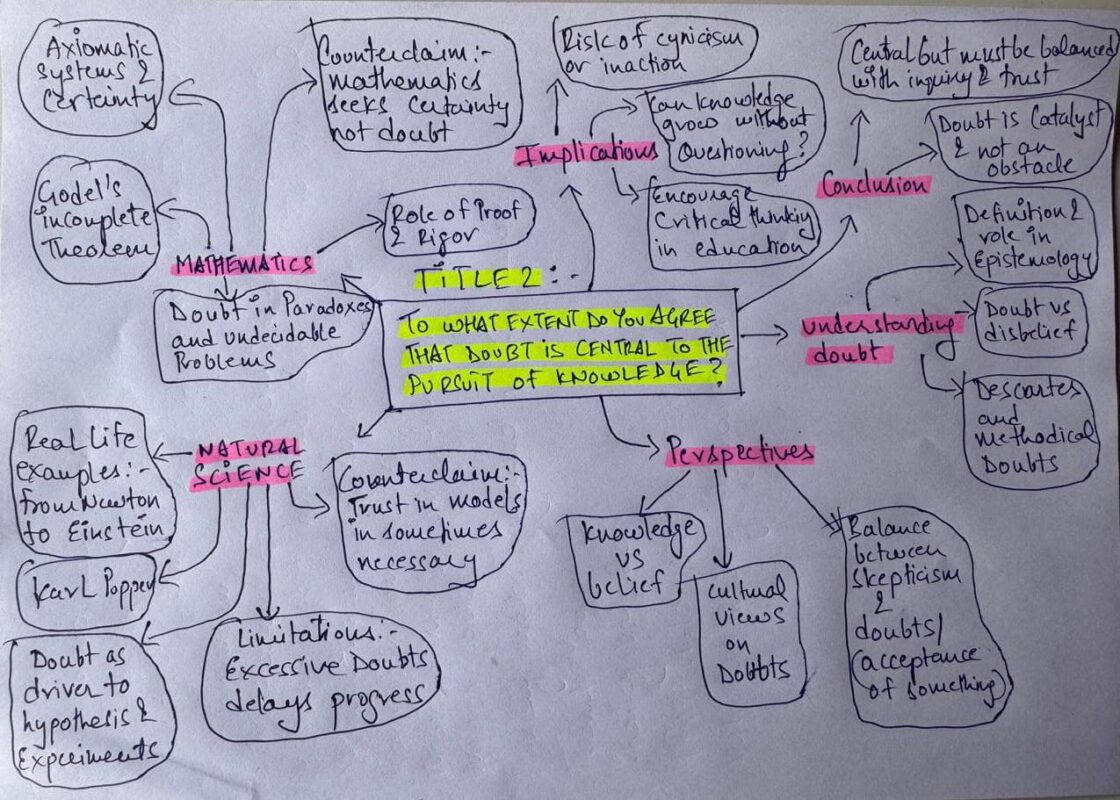
This title centres on the epistemic role of doubt — not as a weakness, but as a driver of inquiry. Doubt challenges certainty and forces scrutiny of claims, which can be especially productive in knowledge systems like the natural sciences, where falsifiability and replication are built into the method itself.
In contrast, the role of doubt in areas like history or ethics may lead to different consequences. Students are invited to reflect on how doubt operates within different knowledge frameworks: is it always beneficial? Is there a limit beyond which doubt becomes destructive? The essay should explore how different AOKs foster or suppress doubt, and whether doubt improves the quality of knowledge or impedes progress. The challenge is to avoid vague generalisations and instead apply the concept of doubt in focused, well-contextualised scenarios drawn from real knowledge practices.
Table of Contents
1. Introduction
Begin by unpacking the key terms of the prompt. A strong introduction shows the examiner you are not treating the title as a slogan — you are interrogating it.
- “Doubt” — the impulse to question the validity, sources, and methods behind knowledge claims.
- “Pursuit of knowledge” — the active processes through which beliefs are tested, challenged, refined, and accepted.
- “Central” — necessary, structurally embedded, indispensable rather than incidental.
- “To what extent” — invites a graded answer, not a binary yes/no.
Interpretation of “doubt is central”
- Is doubt a motivator or a hindrance in knowing?
- Link to TOK concepts: certainty, justification, critical thinking.
- When does doubt fuel discovery — and when does it become denial?
Chosen Areas of Knowledge: Natural Sciences and History.
Position stated: doubt is central, but only when it leads to constructive inquiry —
its productiveness or destructiveness depends on how each AOK channels it.
Stuck framing your thesis on doubt?
Get a working draft in 60 minutes with an IB examiner — no waiting list.
2. Area of Knowledge 1 — Natural Sciences (Claims)
Claim 1 — The Einstein–Rupp experiments: doubt as catalyst
In the early 1920s, physicist Emil Rupp conducted experiments allegedly confirming Einstein’s theories on wave–particle duality. The validity of his results came under suspicion and was eventually debunked. Despite this, the doubt raised by the questionable experiments contributed to significant theoretical advancements in quantum mechanics. Einstein and others were compelled to refine their ideas, leading to developments such as Heisenberg’s Uncertainty Principle. Even flawed or manipulated data can catalyse meaningful knowledge if doubt motivates scrutiny and revision.
Claim 2 — Doubt as institutional practice in modern science
Scientific methodology embeds doubt structurally. The peer-review process, replication studies, and falsifiability tests are designed to challenge and verify findings before accepting them as knowledge. A notable example is the Reproducibility Project in psychology and biology, which exposed the failure of many prominent studies to be replicated. This institutional doubt led to methodological reforms, including data transparency and pre-registration protocols. Here, doubt isn’t accidental — it is embedded within the pursuit of scientific reliability.
Implication: doubt acts as a productive force in the sciences — constantly refining knowledge rather than paralysing it.
3. Area of Knowledge 2 — History (Claims & Counter-claims)
Claim — Historical re-evaluation through doubt: Pacini vs. Hess
In the early 20th century, the discovery of cosmic rays was long attributed to Victor Hess. However, historical investigation later revealed that Domenico Pacini had conducted earlier and equally critical experiments, which were overlooked due to limited communication and nationalistic bias. Historians, driven by doubt regarding the traditional narrative, examined archives, translated forgotten papers, and restored Pacini’s contributions to the official record. Doubt, here, prompts historical revision and fosters epistemic justice.
Counter-claim — When doubt becomes distortion: historical denialism
While doubt can lead to revision and accuracy, it can also be manipulated. Historical denialism — such as Holocaust denial or conspiracy-based reinterpretations of well-documented events — relies on unjustified doubt to undermine well-substantiated knowledge. Soviet censorship of historical records during the Stalin era is another case where ideologically motivated doubt was weaponised to distort the record. These cases demonstrate how doubt, when disconnected from evidence and method, becomes a tool of distortion rather than discovery.
“Doubt is both torch and trap. The torch lights the path forward; the trap closes the path behind. The TOK student’s job is to know which is which.”
Examiner’s Note · Shailey Valecha · IB Examiner
Don’t treat doubt as one thing. Show its two faces.
“The strongest essays on this title don’t argue that doubt is simply ‘good’ or ‘bad’ — they show that methodical doubt in science and weaponised doubt in history are two different epistemic phenomena. Make that distinction explicit, and your evaluation suddenly has teeth.”
4. Comparative Analysis
- Doubt as methodical in science vs. retrospective in history.
- How peer review, replication and falsifiability institutionalise doubt in the natural sciences.
- How history applies doubt to interpret sources — productive when revising, destructive when denying.
- Where the line sits between healthy scepticism and corrosive denial.
In the Natural Sciences, doubt is embedded into the system — peer review, replication, and falsifiability guard against error. In History, doubt is applied retrospectively, often driven by new evidence or social needs to reinterpret past events. While scientific doubt typically refines knowledge, historical doubt can either correct injustices or dangerously distort narratives. Doubt is central — but its value depends on whether it is anchored in evidence and method, or unmoored from them.
5. Essay Flow — Suggested Paragraph Structure
- Introduction and interpretation of the question.
- Claim — Natural Sciences (Einstein–Rupp experiments).
- Claim — Natural Sciences (Reproducibility Project & institutional doubt).
- Claim — History (Pacini and the rewriting of cosmic-ray discovery).
- Counter-claim — History (denialism and Soviet historical revisionism).
- Comparative evaluation across AOKs.
- Conclusion.
6. Conclusion
Yes, doubt is central to the pursuit of knowledge — but only conditionally. In domains where doubt is methodologically structured, as in the Natural Sciences, it becomes a driver of refinement and progress. In domains where doubt is applied without evidential discipline, as in some episodes of historical denialism, it actively erodes knowledge rather than improving it. The value of doubt depends not on its presence, but on whether it is bound to method, evidence, and intellectual honesty.
Final stance: doubt is central because it forces inquiry — but only when it is disciplined inquiry. Without that discipline, doubt collapses into denial, and denial produces no knowledge at all.

7. Bibliography
- Van Dongen, J. (2007). The interpretation of the Einstein–Rupp experiments and their influence on the history of quantum mechanics. Available at: https://arxiv.org/abs/0709.3226
- Carlson, P., & De Angelis, A. (2010). Nationalism and internationalism in science: the case of the discovery of cosmic rays. Available at: https://arxiv.org/abs/1012.5068
- Popper, K. (1959). The Logic of Scientific Discovery. Hutchinson & Co.
- Kuhn, T. S. (1962). The Structure of Scientific Revolutions. University of Chicago Press.
- Open Science Collaboration. (2015). Estimating the reproducibility of psychological science. Science, 349(6251).
More from the Sev7n archive
TOK Essay Examples — read how a working argument is built
Twelve full TOK essays, examiner-graded and dissected. Read them, borrow the method — not the words.
Pick your TOK crisis.
Four kinds of students book this session. Find yourself below — same product, different framing.
Your TOK essay, rescued in 60 minutes.
Bring your draft — or a panicking half-plan. An examiner will diagnose your argument and fix AOK linking.
Rescue my essay →Don’t submit until an examiner has seen it.
60 minutes with an IB examiner. The gap between a 6 and an 8 is usually one conversation.
Reserve my slot →Sit with the examiner. Fix the essay.
Structure. AOK depth. Counter-claims. Conclusion force. Leave with a mark-scheme-ready draft.
Pay & book now →Stop guessing what examiners want.
An IB examiner reads your draft, pinpoints mark-loss, and rebuilds your argument with you. Live.
Book my review →All four sessions are the same product — ₹2,999 · 60 min · 1:1 with an IB examiner. The card just helps you frame your need.
Your TOK Grade · Handled
Reading an outline is one thing. Writing yours is another.
Book a free 20-minute consult with an IB examiner. We’ll review your prescribed title, sketch your argument structure, and tell you exactly what to do next.
Book my free consult →