TOK Exhibition Sample — “Are some things unknowable?”
A complete worked TOK exhibition for IA Prompt 18, with three real-world objects, rationales and examiner commentary — written by SEV7N’s panel of IB-certified examiners for the IB DP May 2026 assessment.
IB examiners. Your grade. Guaranteed lift.
Your first class is free — worth ₹3,500. No pitch, no pressure.
Thank you!
Your message has been received. Our team will reach out to you shortly.
In the meantime — feel free to explore more TOK resources below.
Need us sooner?
📱 WhatsApp us at +91 97172 29659A worked sample for IA Prompt 18 — Are some things unknowable?
In this TOK exhibition sample, we explore IA Prompt 18 — “Are some things unknowable?” — through three real-world objects. The sample is built on the Core Theme and demonstrates how to align the prompt, the objects and the rationale within the IB’s 950-word commentary cap.
To highlight the nature of this IA prompt, students must understand that knowledge comes with limitations — and sometimes, despite our best instruments and most careful reasoning, certain things remain beyond our reach. The prompt asks the knower to confront the boundary between what is known, what is yet to be known, and what may forever resist being known.
The question arises: what is unknowable? And how do we measure or identify the degree to which we know them? Does knowing only a sliver of something count as unknowable? Or even when we know a great amount of information about something — but not fully — does that still count?
This IA prompt presents the opportunity to choose objects that are unknown, partly known, or stubbornly resistant to knowing. It could be an artwork — a painting whose meaning the painter never disclosed. It can be a mathematical proposition still unproven after centuries. For some, it could be a UFO, a cosmic phenomenon, or an unanswered question from a personal past. The territory is vast.
As the IB TOK guide reminds us, students must anchor their thinking in one of the optional themes or core themes, as this anchor is what makes the connection between the prompt and the objects rigorous. For this sample, we have chosen the Core Theme. The three objects are presented below.
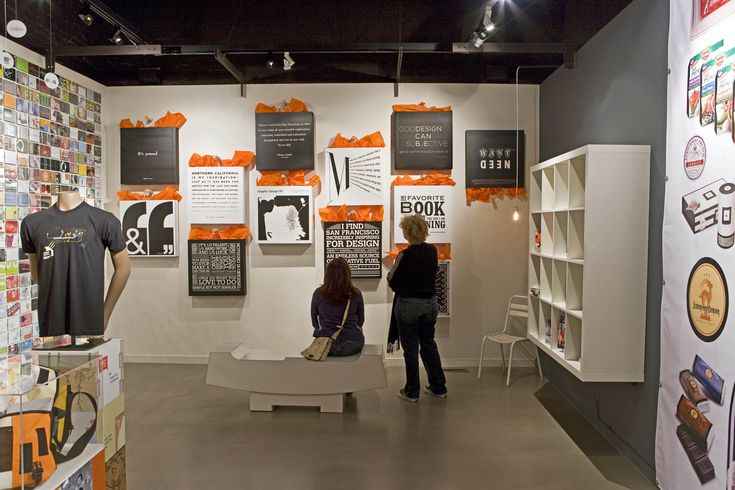
The three objects that anchor this sample
Each object is chosen for its specificity — not its generality. Together they show the prompt’s reach across history, mathematics and personal belief.
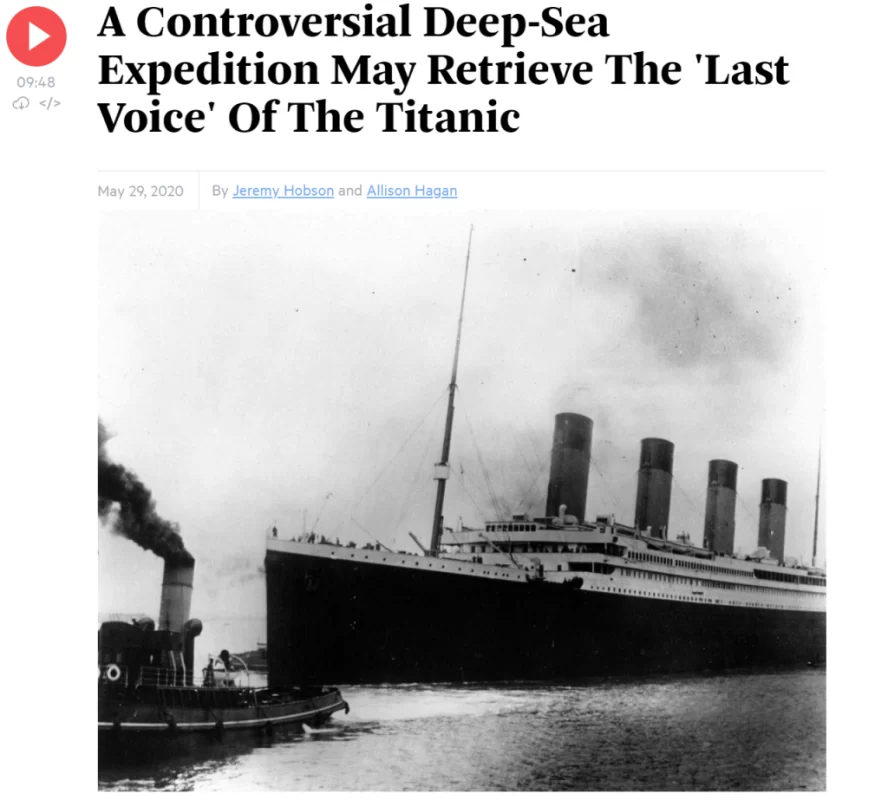
The Titanic Telegraph — a sunken voice
The complete details of this TOK exhibition object can be taken from this source. The idea is to retrieve the Marconi telegraph machine from the shipwreck — to solve the unknown facts of the night the Titanic sank, and possibly recover the last messages sent before she went down.
However, allowing people to retrieve material from the seabed risks plunder, and there is real physical danger in visiting the site itself. For these reasons, both the knowledge and the knower may remain unknown. The object is not generic — it lives in the books of history in a time and virtual space, and its discussion resonates with the very real-world issue of how some things may remain unknowable, even when they sit there waiting to be retrieved.

Goldbach’s Conjecture — a mathematical mystery
While some may claim this object fits in another Area of Knowledge, it equally poses challenges about the knowledge we possess about prime numbers. It raises questionable arguments about the knower’s approach as a real-life application of the conjecture. The details about this TOK exhibition object can be seen here.
The conjecture has been verified for billions of cases — and yet, no general proof exists. We have travelled far enough to almost know it, but never to know it fully. That distinction is the heart of the prompt: knowing-a-lot is not the same as knowing.

The Horoscope — a future glimpsed, never seen
Object 3 is a case of our knowledge about astrology. It is a pure pseudoscience — and knowledge claims about it are relatively untestable. My friend, who is a Virgo, has not seen a single forecast come true; yet she genuinely and regularly looks for horoscope speculations every week.
The ‘Future’ is unknowable, and the very nature of its unknowability is what makes the knower curious. Knowledge about the future is uncertain, requires justification, could be biased, has limitations — and many other things — and the horoscope is a vivid object through which to explore that.
The TOK exhibition requires students to write not more than 950 words on the three exhibition objects chosen. The idea is to find connections between the knowledge and the knower. Sometimes, the knowledge in itself has reached a point where further exploration is not possible due to certain limitations — material, methodological, or personal.
Students must retain their focus on the nature of the knowledge — and how the knower plays an important part in exploring and finding ways to go beyond the current set of truths available. This is what justifies the use of the objects in connecting with the ‘unknowable’ in IA Prompt 18.

Need help with your TOK exhibition?
Get one-to-one guidance from an IB-certified examiner — IA prompt selection, three-object alignment, and rubric-based draft review within the 950-word cap.
All 35 IA Prompts for the TOK Exhibition
Click any IA prompt to open a detailed guide with 5 worked object examples, rationales and examiner commentary — written by SEV7N’s panel of 182+ IB-certified examiners.
Ready to turn your TOK exhibition into a top-band submission?
Join 700+ IB students already working with SEV7N’s IB-certified examiners. Book a free demo today — your first class is free, worth ₹3,500.