Can we only understand something to the extent that we understand its context?
A free, examiner-graded breakdown of TOK Title 4 for May 2026 — full outline, claim & counter-claim structure, two AOKs (History + Natural Sciences), and a complete sample answer. Written by IB examiners at Sev7n.
Theory of Knowledge · May 2026 · Title 4
The full outline & sample answer
A complete examiner-graded breakdown — interpretation, claims in History, counter-claims in Natural Sciences, comparative analysis, and a working sample essay.
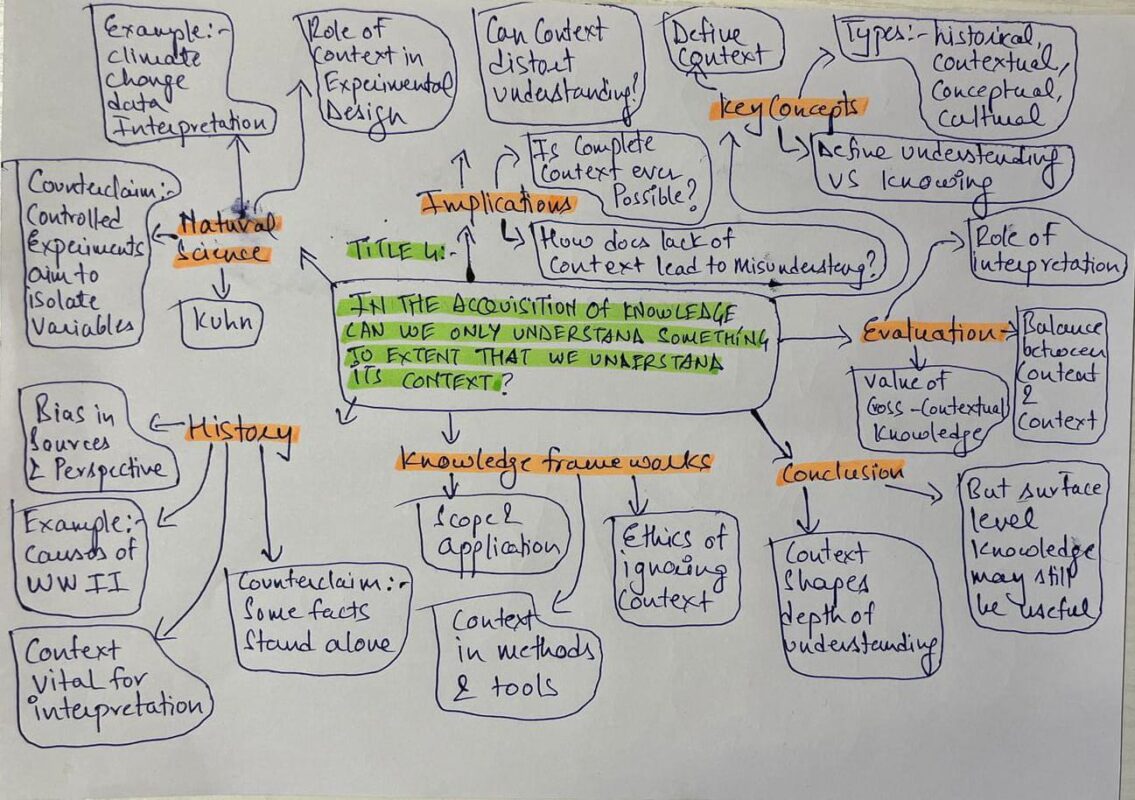
This title asks whether genuine understanding is possible without context. It is especially relevant in areas like history, where knowledge often emerges from interpreting events, actions, or documents within broader political, social, and cultural settings. But how important is context in other areas, like the natural sciences or ethics?
Students will need to reflect on how context influences the meaning, interpretation, and reliability of knowledge claims — and whether some forms of knowledge are more context-dependent than others. Can we fully understand a scientific law without knowing how or why it was developed? Can moral principles be understood outside the culture they arose in? This title pushes students to explore how the depth of understanding is shaped by the frameworks surrounding knowledge.
Table of Contents
1. Introduction
Begin by unpacking the key terms of the prompt. A strong introduction shows the examiner you are not treating the title as a slogan — you are interrogating it.
- “Acquisition of knowledge” — the process by which knowledge is gained, encountered, or absorbed by the knower.
- “Understand” — more than knowing facts; interpreting meaning, implications, and significance.
- “Context” — historical, cultural, conceptual, methodological, or environmental surroundings of a knowledge claim.
- “Only…to the extent” — the prompt is conditional, not absolute. The examiner wants nuance, not a yes/no.
Interpretation of “only to the extent that we understand its context”
- Is context a condition for understanding, or only an enrichment of it?
- Does the role of context change between interpretive AOKs and universal/empirical AOKs?
- What happens to knowledge when its context is partial, distorted, or lost entirely?
Chosen Areas of Knowledge: History and Natural Sciences.
Position stated: understanding is deeply dependent on context in interpretive AOKs like
history, but in the natural sciences, certain knowledge can function reliably even when context is minimal —
context enriches knowledge but is not always essential.
Stuck on framing your introduction?
Get a working draft in 60 minutes with an IB examiner — no waiting list.
2. Area of Knowledge 1 — History (Claims)
Claim 1 — Historical events cannot be understood without sociopolitical and temporal context
The French Revolution cannot be understood as a sequence of events alone. Without knowing the intellectual climate of the Enlightenment, the financial crisis of the late 18th century, and the structure of the ancien régime, the storming of the Bastille reads as a riot rather than a rupture in political philosophy. Context here is not decoration — it is what converts events into meaning.
Claim 2 — Context allows multi-perspective interpretation, deepening understanding
Decolonisation narratives told from a British colonial perspective and from indigenous viewpoints produce strikingly different histories of the same events. Each context — its language, its archives, its sense of grievance and legitimacy — frames what counts as evidence and what counts as cause. Understanding deepens precisely because context multiplies.
Implication: in history, context is not an optional layer added to the facts — it is the very medium through which facts become interpretable. Strip away context, and history collapses into chronology.
Sub-claim — Context as necessary for interpreting historical artifacts
Consider the medieval Mappa Mundi tradition, such as the Bavarian world map of 1459. Without knowing the religious worldview that placed Jerusalem at the centre of the world, the map looks like a geographical error. Within its context, it is a coherent theological statement. The map is itself a knowledge artifact whose meaning is unrecoverable without its surrounding belief system.
3. Area of Knowledge 2 — Natural Sciences (Counter-claims)
Counter-claim 1 — Scientific knowledge often transcends cultural or contextual origins
Newton’s laws of motion are applied today in every country, regardless of whether the engineer using them has read the Principia or knows anything about 17th-century English natural philosophy. The functional understanding required to send a satellite into orbit does not depend on Newton’s theological commitments or his disputes with Leibniz. In this sense, scientific knowledge can be decontextualised without loss of operational meaning.
Counter-claim 2 — Context aids appreciation, not functional understanding
The double-helix structure of DNA is the same molecule regardless of who discovered it or when. Knowing the disputed history of Rosalind Franklin’s contribution adds historical and ethical dimensions to the discovery, but it does not change what DNA is. A geneticist working in a lab today operates with full functional understanding of the molecule without rehearsing its discovery context.
Sub-claim — Scientific laws hold under controlled conditions with minimal context
Boyle’s Law, relating the pressure and volume of an ideal gas, holds reliably under controlled conditions. You don’t need to understand 17th-century Irish science or the politics of the Royal Society to predict gas behaviour in a sealed container. Modern microgravity experiments on the International Space Station continue to confirm Boyle’s Law even where the gravitational context is radically different — the law travels well precisely because it is abstracted from local context.
“In history, context is the medium of meaning. In the natural sciences, context is often the scaffolding that we eventually take down once the building stands.”
Examiner’s Note · Shailey Valecha · IB Examiner
Don’t answer “yes” or “no.” Answer “to what extent, and where.”
“The weakest essays on this title pick a side and stick to it. The strongest ones show that context is essential in some AOKs, enriching in others, and occasionally recoverable even when partly lost. Mark the prompt closely: ‘only to the extent that’ is asking for a calibration, not a verdict.”
4. History — Counter-claim (Lost Context, Surviving Knowledge)
Even within history itself, the dependence on context is not absolute. The Rhind Mathematical Papyrus (c. 1650 BCE) records ancient Egyptian arithmetic and geometry, including approximations for the area of a circle. Much of its surrounding context — the scribal schools, religious symbolism, social hierarchy — is partly lost. Yet the mathematical content is sufficiently clear that modern students can still follow and verify the methods. Some knowledge survives the erosion of its context.
This complicates the prompt: context is necessary for understanding why something was done, but not always for understanding what was done.
5. Comparative Analysis
- History relies on context to convert events into meaning; without it, interpretation collapses.
- Natural Sciences abstract away from context to achieve generalisation and predictive power.
- “Understanding” is itself AOK-dependent: in history it means grasping motive, worldview, and significance; in science it often means being able to predict, replicate, or model.
- Lost context can produce shallow or distorted understanding — but not always fatal misunderstanding, as the Rhind Papyrus shows.
- Misunderstood context can be worse than missing context: it produces confident misreadings (e.g., judging a medieval map by modern cartographic standards).
The relationship between context and understanding is therefore graded, not binary. The natural sciences can achieve robust functional understanding with thin context; history cannot achieve interpretive understanding without thick context. Both are legitimate forms of knowledge — they just stand in different relations to the contexts that produced them.
6. Essay Flow — Suggested Paragraph Structure
- Introduction and interpretation of the question.
- Claim — History (French Revolution & Enlightenment context).
- Claim — History (decolonisation narratives, multi-perspective).
- Counter-claim — Natural Sciences (Newton’s laws applied globally).
- Counter-claim — Natural Sciences (Boyle’s Law / DNA structure).
- Counter-claim within History (Rhind Papyrus — surviving knowledge despite lost context).
- Comparative evaluation and weighing of contextual dependency.
- Conclusion.
7. Conclusion
Yes, in many cases — especially in interpretive AOKs like history — we can only understand something to the extent that we understand its context. Strip away context and historical events become unreadable, artifacts become curiosities, and competing narratives collapse into noise. But the natural sciences offer a calibrating counter-case: scientific laws and structures often function reliably even when their cultural and historical context is unknown to the user.
Final stance: context is essential for interpretive understanding and enriching for functional understanding. The prompt’s “only to the extent” is not a limit on knowledge — it is a reminder that understanding is always indexed to the kind of question we are asking.

8. Bibliography
- Collingwood, R. G. (1946). The Idea of History. Oxford University Press.
- Kuhn, T. S. (1962). The Structure of Scientific Revolutions. University of Chicago Press.
- Robins, G. & Shute, C. (1987). The Rhind Mathematical Papyrus: An Ancient Egyptian Text. British Museum Publications.
- O’Raifeartaigh, C. (2013). The Contribution of V. M. Slipher to the Discovery of the Expanding Universe. arXiv:1212.5499.
- Edson, E. (1997). Mapping Time and Space: How Medieval Mapmakers Viewed Their World. British Library.
More from the Sev7n archive
TOK Essay Examples — read how a working argument is built
Twelve full TOK essays, examiner-graded and dissected. Read them, borrow the method — not the words.
Pick your TOK crisis.
Four kinds of students book this session. Find yourself below — same product, different framing.
Your TOK essay, rescued in 60 minutes.
Bring your draft — or a panicking half-plan. An examiner will diagnose your argument and fix AOK linking.
Rescue my essay →Don’t submit until an examiner has seen it.
60 minutes with an IB examiner. The gap between a 6 and an 8 is usually one conversation.
Reserve my slot →Sit with the examiner. Fix the essay.
Structure. AOK depth. Counter-claims. Conclusion force. Leave with a mark-scheme-ready draft.
Pay & book now →Stop guessing what examiners want.
An IB examiner reads your draft, pinpoints mark-loss, and rebuilds your argument with you. Live.
Book my review →All four sessions are the same product — ₹2,999 · 60 min · 1:1 with an IB examiner. The card just helps you frame your need.
Your TOK Grade · Handled
Reading an outline is one thing. Writing yours is another.
Book a free 20-minute consult with an IB examiner. We’ll review your prescribed title, sketch your argument structure, and tell you exactly what to do next.
Book my free consult →