Does it matter that observation is an essential but flawed tool?
A free, examiner-graded breakdown of TOK Title 1 for May 2026 — full outline, claim & counter-claim structure, two AOKs (Natural Sciences + History), and a complete sample answer. Written by IB examiners at Sev7n.
Theory of Knowledge · May 2026 · Title 1
The full outline & sample answer
A complete examiner-graded breakdown — interpretation, claims in Natural Sciences, counter-claims in History, comparative analysis, and a working sample essay.
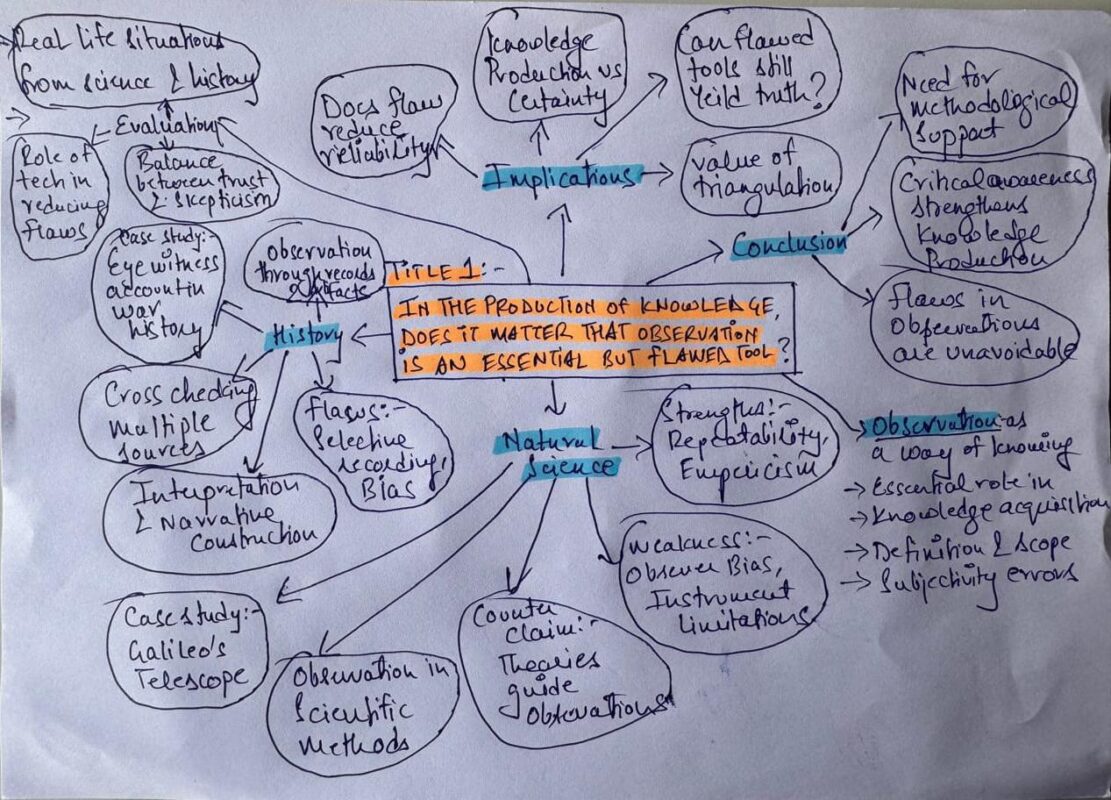
This title invites exploration of a fundamental tension in knowledge production: the dependence on observation as a source of knowledge, and its inherent fallibility. Observation, as a way of knowing, is critical in areas like the natural sciences, where it underpins experimentation and empirical research. However, observation is not a neutral tool; it is shaped by the observer’s perspective, the instruments used, and the theoretical frameworks guiding inquiry.
In exploring this title, students must consider how much we can trust what we see or measure, and whether knowledge remains valid even when the tools of discovery are flawed. The essay should not only address empirical methods, but also include reflection on contrasting AOKs, such as history or the arts, where observation may play a different role.
Table of Contents
1. Introduction
Begin by unpacking the key terms of the prompt. A strong introduction shows the examiner you are not treating the title as a slogan — you are interrogating it.
- “Production of knowledge” — the active processes through which knowledge is created, validated and refined.
- “Observation” — the act of gathering information through the senses or instruments, in service of inquiry.
- “Essential” — without which the production of knowledge in that AOK would not function.
- “Flawed” — limited by bias, instrument error, framework, or human perception.
Interpretation of “essential but flawed tool”
- What qualifies a tool as “essential” in knowledge production?
- What makes it “flawed” — limitations, biases, errors?
- Parameters for evaluating reliability in knowledge tools.
Chosen Areas of Knowledge: Natural Sciences and History.
Position stated: observation is necessary but contextually limited — its “flaw” matters
differently across AOKs depending on how each handles it.
Stuck on framing your introduction?
Get a working draft in 60 minutes with an IB examiner — no waiting list.
2. Area of Knowledge 1 — Natural Sciences (Claims)
Claim 1 — Observation drives empirical discovery
Scientific discoveries often begin with observation. The discovery of penicillin by Alexander Fleming began with accidental observation. Though flawed (he did not initially intend to study antibacterial properties), it led to a revolutionary understanding. Even flawed observation can produce valid knowledge.
Claim 2 — Flawed observation is mitigated by methodology
In particle physics, observations of subatomic particles are indirect and require confirmation through multiple tools and experiments (e.g., cloud chambers, bubble chambers). Science corrects and compensates for observational limits through replication, peer review and triangulation.
Implication: despite imperfections, observation is foundational in the sciences — and the discipline’s strength lies in how it audits its own observations.
3. Area of Knowledge 2 — History (Counter-claims)
Counter-claim 1 — Observation in history is filtered through interpretation
Historians observe through sources — documents, artifacts, testimonies. These are prone to bias and contextual framing. Conflicting historical accounts of the colonisation of Africa, or eyewitness testimonies of the Partition of India, demonstrate how observational interpretation can diverge significantly even when the underlying events are the same.
Counter-claim 2 — Eyewitness accounts are vulnerable to distortion
Memory studies (e.g., Elizabeth Loftus’s work) show that recollection is fallible. In history, reliance on such observation affects the authenticity of narratives. Re-analysis of Columbus’s “discovery” from indigenous perspectives shows that historians often reinterpret observations using the present context — flawed observation creates contested narratives.
“Historical observation is layered, interpretive and unstable — but that doesn’t make it less valuable. It makes it more honest.”
Examiner’s Note · Shailey Valecha · IB Examiner
Don’t list AOKs. Stage a debate between them.
“The strongest essays on this title don’t just describe how science and history each handle observation — they put the two AOKs in direct conversation. Show how the natural sciences repair flawed observation, and how history embraces it as interpretation. That contrast is where the marks live.”
4. Comparative Analysis
- How science repairs flawed observation vs. history embracing interpretive layers.
- Essentiality of observation across both AOKs — in different forms.
- Where observation fails: limits and risks.
- What this says about our standards of “truth” in knowledge production.
The Natural Sciences embrace observation’s flaws by embedding validation processes, reducing individual bias. In contrast, History struggles more with subjectivity, as observation often comes second-hand. Observation’s flaw is not universally detrimental — it depends on how each AOK responds to and manages those flaws.
5. Essay Flow — Suggested Paragraph Structure
- Introduction and interpretation of the question.
- Claim — Natural Sciences (Franklin’s DNA / Fleming).
- Claim — Natural Sciences (Millikan’s experimental flaws).
- Counter-claim — History (Partition narratives).
- Counter-claim — History (Columbus reinterpretation).
- Evaluation and weighing up of claims.
- Conclusion.
6. Conclusion
Yes, it does matter that observation is flawed — especially in domains where subjective or anecdotal observation plays a central role. However, when observation is integrated with verification mechanisms, as in the Natural Sciences, its flaws become a manageable variable rather than a fatal flaw. The value of observation in knowledge production lies in how it is treated, tested, and contextualised within each AOK.
Final stance: observation matters because it is flawed. Flaw forces method; method forces honesty; honesty produces trustworthy knowledge.

7. Bibliography
- Fleming, A. (1929). On the Antibacterial Action of Cultures of a Penicillium. British Journal of Experimental Pathology.
- Loftus, E. F. (2005). Planting misinformation in the human mind: A 30-year investigation of the malleability of memory. Learning & Memory.
- Collins, H. (2010). Tacit and Explicit Knowledge. University of Chicago Press.
- Kuhn, T. S. (1962). The Structure of Scientific Revolutions. University of Chicago Press.
More from the Sev7n archive
TOK Essay Examples — read how a working argument is built
Twelve full TOK essays, examiner-graded and dissected. Read them, borrow the method — not the words.
Pick your TOK crisis.
Four kinds of students book this session. Find yourself below — same product, different framing.
Your TOK essay, rescued in 60 minutes.
Bring your draft — or a panicking half-plan. An examiner will diagnose your argument and fix AOK linking.
Rescue my essay →Don’t submit until an examiner has seen it.
60 minutes with an IB examiner. The gap between a 6 and an 8 is usually one conversation.
Reserve my slot →Sit with the examiner. Fix the essay.
Structure. AOK depth. Counter-claims. Conclusion force. Leave with a mark-scheme-ready draft.
Pay & book now →Stop guessing what examiners want.
An IB examiner reads your draft, pinpoints mark-loss, and rebuilds your argument with you. Live.
Book my review →All four sessions are the same product — ₹2,999 · 60 min · 1:1 with an IB examiner. The card just helps you frame your need.
Your TOK Grade · Handled
Reading an outline is one thing. Writing yours is another.
Book a free 20-minute consult with an IB examiner. We’ll review your prescribed title, sketch your argument structure, and tell you exactly what to do next.
Book my free consult →