
Theory of Knowledge
Knowledge Frameworks – Theory of Knowledge
Methods and Tools – Theory of Knowledge
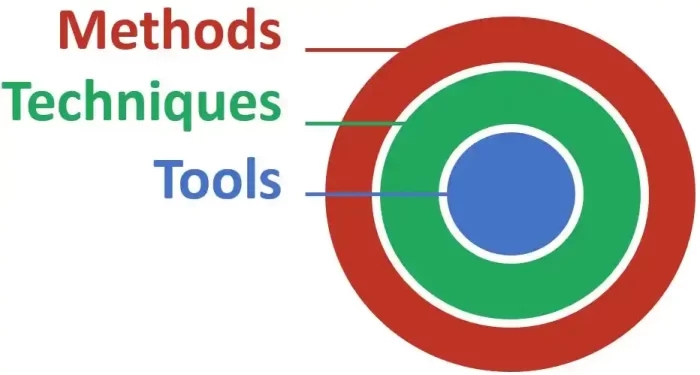
The “Methods and Tools” element of the knowledge framework in Theory of Knowledge dives into the practical side of how we produce knowledge. It’s about the “how-to” – the specific processes, practices, and instruments that different Areas of Knowledge use to discover, create, and validate what they claim to know. This includes everything from the scientific method in the natural sciences to artistic techniques in the arts, and the conceptual frameworks that shape how disciplines operate. It also considers the actual “tools” we use, whether they’re cognitive (like critical thinking) or material (like telescopes or computers), and how technology has transformed these methods. Understanding this element is key to appreciating the unique ways each field generates and shares its insights within the broader Theory of Knowledge.
This line of knowledge framework focuses on explaining the ways in which knowledge can be acquired. It puts forward the disciplines through which the knowledge can be obtained. The improvements in the way knowledge is being collected, especially due to the infusion of time and development. Like how books shifted from being the prime source of information to the internet being the free-way source of knowledge and communication all over the world.

Knowledge framework – Theory of Knowledge
Knowledge questions
Does what is seen to constitute “good evidence” vary from discipline to discipline and culture to culture? How is knowledge produced and communicated in these themes/areas of knowledge?
Evidence is a piece of information upon which we base our judgment or conclusion. “Good” evidence is something that is reliable, authentic, understandable, and representing the situation. The evidence should be scrutinised well before being taken for support. Evidence takes a different purview depending on what it is representing.
Let’s take the example of how evidence differs in two different systems, Natural Science and Religion.
Empirical Evidence is the evidence that is derived from careful experimentation and observation. This kind of evidence is usually used in the reasoning of problems related to natural science. Whereas religion and faith have very little chance of being solved by the use of empirical evidence. Religion is contemplated using traditions and other cultural practices. It can be neutrally said that finding answers in science is based on experimental evidence, and in religion, it is experiential evidence.
When a scientific fact is questioned, it can be conveyed using facts and experimental derivations but when it comes to faith or religion, it is deduced that most of the time religion is unresponsive to evidence, there are just claims and no supporting evidence to prove it is right.
Now, let’s move onto something interesting where science has interestingly collided with Hindu mythology. In Hindu mythology, they worship a deity named Vishnu, who is said to have ten different avatars. It is called “Dasha avatars”. This synopsis has a resemblance to the theory put forward by Charles Darwin.
The production of knowledge is mostly based on observations and experiments on the same. This brings into light new theories and understandings. Be it any field of knowledge, the production of knowledge mostly takes place in such a way. Humans have always found a way to organise information and taken the initiative in finding ways to communicate the same.
The document attached below gives us a very broad perspective on how knowledge is produced. Ways of knowing, along with observation and experimentation, bring out to be the main elements in the production of knowledge.
In the below video, we get to see a very unique way of how trees were used as part of explaining the history and whatnot. The exploration by the Infographic expert is commendable.
How important are material tools in the production and acquisition of knowledge?
Material tools are a comprehensive part of the production and acquisition of knowledge. The insight into a particular system of learning can be acquired through the ways in which people used to etch their information. The examples of cave drawings which is an essential tool of knowledge that helps us in taking back to a different time, and the different components of the drawing, the materials used for the pictorial representations will give us an idea of how life was during that period.
Genevieve von Petzinger, A Paleoanthropologist and rock decoder guide us through the way of understanding how 1000’s years ago, why our ancestors have inscribed geometrical figures, and what they might have possibly intended through them.
But again, the material tool can also be difficult to trace through and basically survives on the various interpretations scientists and researchers have found over the years to assist in giving a clearer meaning. So, even when a particular tool helps us in the production and acquisition of knowledge, it equally needs human intervention to convert into a moulded form that can be conveyed to the masses.
Acquisition of knowledge can be considered a difficult conditioning process. There has to be extra careful while we construe information on everything around us, be it in the past, present or future.
What assumptions underlie the methods of inquiry used in these themes/areas of knowledge?
Every method of inquiry, no matter how rigorous, often rests on certain fundamental assumptions. These aren’t always explicitly stated but are crucial to how knowledge is produced. Take, for example, the scientific method in the natural sciences. A core assumption is that the natural world is orderly and consistent – meaning that if you repeat an experiment under the same conditions, you should get the same results. This is often called the “uniformity of nature.” Without this assumption, scientific laws and theories, which aim to describe universal regularities, wouldn’t be possible. If gravity worked differently on Tuesday than on Monday, physics as we know it would collapse!
Another assumption in many scientific inquiries is that observation can provide objective information about reality. While scientists strive for objectivity, this still assumes our senses and instruments can reliably capture features of the world. In the human sciences, a common assumption in quantitative research (like surveys) is that human behaviour can be measured, categorised, and analysed statistically, and that large samples can represent broader populations. In history, historians often assume that past events leave behind reliable evidence that can be interpreted to reconstruct what happened, even if some evidence is missing or biased. Recognising these underlying assumptions within the “scope” of their methods helps us critically evaluate the knowledge claims produced in each area in Theory of Knowledge.
How is knowledge produced and communicated in these themes/areas of knowledge?
The process of generating and sharing knowledge differs significantly across fields. In mathematics, knowledge is primarily produced through abstract reasoning, logical deduction, and proof. Mathematicians don’t run experiments; they develop theorems and axioms, and then use logical steps to derive new, undeniable truths. The “tools” are symbols, logical operators, and rigorous proofs. This knowledge is then communicated through peer-reviewed mathematical journals, textbooks, and academic conferences, where new proofs are presented and scrutinized by other mathematicians. The clarity and precision of mathematical language are essential for this communication.
Now consider the Arts. Knowledge in this area isn’t typically “produced” through experiments or logical proofs, but rather through creative expression, intuition, and interpretation. A musician “produces” knowledge about human emotion or cultural experience through composing and performing music. A painter creates visual knowledge through their use of color, form, and symbolism. The “tools” here are instruments, paints, brushes, words, and the human body. This knowledge is communicated through performances, exhibitions, concerts, literature, and visual media. The audience then “acquires” this knowledge through their sensory and emotional engagement, often interpreting it personally. Unlike the explicit communication of a scientific paper, artistic communication is often evocative and relies on shared human experience, expanding the “scope” of communication within the Theory of Knowledge.
The choice of methods and tools for the acquisition of knowledge has to be taken with respect to the kind of information we are dealing with. There is no one-stop method that sits well with all kinds of fields of knowledge. Hence, one shall take proper scrutiny while attempting to figure out the right medium.
You may want to check out other frameworks of the Theory of Knowledge, such as perspectives and scope.