

To what extent is interpretation a reliable tool in the production of knowledge?
A free, examiner-graded breakdown of TOK Title 6 for May 2026 — full outline, claim & counter-claim structure, two AOKs (History + The Arts), and a complete sample answer with rare, essay-distinguishing examples. Written by IB examiners at Sev7n.
Theory of Knowledge · May 2026 · Title 6
The full outline & sample answer
A complete examiner-graded breakdown — interpretation, claims in History, counter-claims and parallel claims in The Arts, comparative analysis, and a working sample essay.
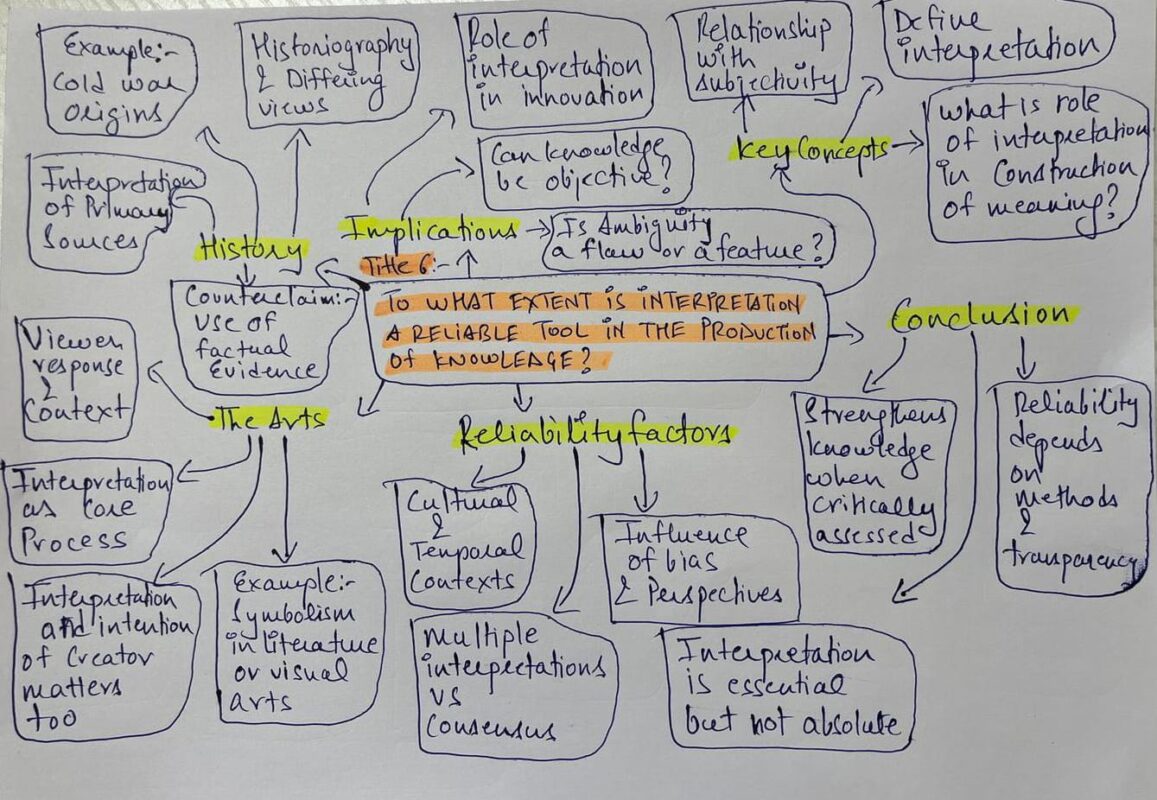
Interpretation is central to many areas of knowledge, particularly those where knowledge is constructed from incomplete or ambiguous evidence. This title asks whether interpretation can be considered a reliable tool — or if it introduces too much subjectivity into the knowledge production process. The trap most students fall into is treating “interpretation” as a synonym for “opinion.” It is not. In the disciplines, interpretation is a method — disciplined, transparent, and answerable to evidence.
In history, interpretation allows us to reconstruct past events, but it can also lead to competing narratives. In areas like the arts, interpretation isn’t just part of knowledge — it is the knowledge itself. Students must reflect on when interpretation enhances understanding, and when it obscures or distorts it. The reliability of interpretation, and the conditions under which it holds, will be central to this investigation.
Table of Contents
1. Introduction
Begin by unpacking the key terms of the prompt. A strong introduction shows the examiner you are not treating the title as a slogan — you are interrogating it.
- “Interpretation” — the process of assigning meaning to evidence, events, works, or data.
- “Reliable” — consistent, justified, defensible across multiple knowers, with minimal distortion.
- “Tool” — a method or instrument used purposefully in the production of knowledge.
- “Production of knowledge” — the active processes through which knowledge is created, validated, and refined.
Central inquiry & framing
- Is interpretation a gateway to meaning, or a filter of bias?
- What conditions make interpretation reliable in one AOK and unreliable in another?
- TOK themes engaged: justification, evidence, perspective, methodology.
Chosen Areas of Knowledge: History and The Arts.
Position stated: interpretation is essential and often reliable when anchored in
evidence, transparent assumptions, and disciplinary method — yet there are domains and situations
where its limits undermine its trustworthiness. Reliability is a property of how
interpretation is done, not of interpretation itself.
Stuck on framing your introduction?
Get a working draft in 60 minutes with an IB examiner — no waiting list.
2. Area of Knowledge 1 — History (Claims & Counterclaims)
Claim 1 — Interpretation recovers suppressed voices
Consider the work on Neo-Slavery archives in Portuguese colonial Africa. Researchers have unearthed oral testimonies and hidden documents — often buried inside former colonial court records — to reinterpret legal and cultural norms about slavery, challenging the colonial narrative that minimised local agency. This required interpreting fragmentary texts, testimonies, and indigenous languages alongside the official Portuguese record.
Interpretation here is reliable because historians triangulated between oral tradition, court records, linguistic evidence, and material artefacts. The interpretation recovers knowledge that would otherwise be lost if one relied only on dominant written sources. Yet, it demands careful method, awareness of power structures, and constant cross-checking to avoid imposing modern framings on historical voices.
Counterclaim 1 — Interpretation produces competing, contradictory narratives
The interpretation of Hittite imperial inscriptions is a less-cited but powerful counterexample. Some scholars argue these inscriptions show economic centralisation under a strong king; others, working from the same fragmentary tablets, argue for localised autonomy and weak central control. Same evidence — opposite conclusions.
Although interpretation is necessary, reliability suffers when frameworks differ widely and when evidence is sparse or ambiguous. Different interpreters arrive at divergent, incompatible conclusions. In such cases, interpretation may be less reliable for establishing “what actually happened” than for exploring possible meanings — a humbler but still valuable role.
Implication: in history, interpretation’s reliability lives in sourcing, comparison, and transparency — not in the interpreter’s confidence.
3. Area of Knowledge 2 — The Arts (Claims & Counterclaims)
Claim 2 — Interpretation is enrichment of meaning
Consider a multimedia work by an Indigenous artist combining traditional weaving patterns with digital soundscapes. The interpretation doesn’t just rest on what is seen or heard, but on the weaving’s traditional knowledge, the symbolism of patterns, and how viewers connect with that layered work.
Interpretation here allows the knowledge embedded in the artwork to be accessible at many levels; it enables multiple valid readings, and the richness comes from this interpretive flexibility. Reliability is found not in a single “correct” meaning but in interpretive coherence, depth, and relation to context. In The Arts, “reliable” does not mean “singular.”
Counterclaim 2 — Interpretation distorts when context is lost
When Indigenous art is interpreted by Western curators for Western galleries, symbols may be reinterpreted — or misinterpreted — to fit gallery-goer expectations, thereby altering or diminishing original meaning. The work is still “read,” but the reading is unreliable: it severs the object from the cultural knowledge that makes it intelligible.
The power of interpretation is constrained by who is interpreting, for whom, and under what cultural assumptions. When context is lost or reshaped, the interpretation may become unreliable or misleading, even when well-intentioned. Reliability collapses the moment interpretation forgets that it is situated.
“Interpretation is not the opposite of evidence. It is what evidence does once it meets a mind that knows how to listen to it.”
Examiner’s Note · Shailey Valecha · IB Examiner
Don’t defend interpretation. Discipline it.
“Weak essays on Title 6 spend three pages defending interpretation as if the examiner is attacking it. Strong essays do something harder — they show under what conditions interpretation is reliable, and under what conditions it isn’t. Use History to show how method makes interpretation answerable; use The Arts to show how interpretation can be both essential and destructive depending on cultural context. The mark scheme rewards the contrast, not the conclusion.”
4. Comparative Analysis
- History strives toward objectivity in interpretation via cross-sources, archival evidence, and historiography. The Arts find reliability through coherence, empathy, and contextual respect — not through convergence on a single reading.
- How does the need for narrative (history) differ from the need for resonance (the arts)?
- Can interpretation be trained or disciplined to be more reliable? Both AOKs answer yes — but the discipline looks different in each.
- Is interpretation a strength or a vulnerability? Both. The vulnerability is what makes the strength worth having.
History and The Arts converge on the same uncomfortable truth: interpretation is unavoidable, and so reliability cannot mean “interpretation-free.” It must mean “interpretation done well.” The criteria — evidence base, transparency of assumptions, perspectives considered, contextual fidelity — apply across both AOKs even though the methods differ.
5. Essay Flow — Suggested Paragraph Structure
- Introduction and stance — interpretation is reliable when disciplined; unreliable when uncritical.
- Claim — History (Neo-Slavery archives, Portuguese colonial Africa).
- Counterclaim — History (Hittite inscriptions, conflicting interpretive frameworks).
- Claim — The Arts (Indigenous multimedia work, layered symbolic interpretation).
- Counterclaim — The Arts (curatorial mis-contextualisation, loss of cultural meaning).
- Synthesis — when interpretation is reliable, why, and how each AOK enforces it.
- Conclusion.
6. Conclusion
Yes, interpretation is reliable — but not unconditionally. Reliability is shaped by discipline, method, and purpose. In History, reliability comes from triangulation, transparency, and humility before the fragmentary record. In The Arts, reliability comes from contextual fidelity and the coherence of layered readings, not from forcing a single “correct” meaning.
Final stance: interpretation is a powerful but context-dependent tool. The deeper TOK reflection is uncomfortable: we cannot ever fully separate interpretation from knowing. The honest question is not “should we trust interpretation?” but “what does it take for our interpretations to deserve trust?”

7. Bibliography
- Research on Neo-Slavery archives in Portuguese colonial Africa — oral histories and archival documents (postcolonial studies journals).
- Scholarly articles on Hittite inscriptions and the disputes between centralisation and local-autonomy interpretations (Near Eastern studies / archaeology).
- Documentation of Indigenous multimedia art combining traditional craft with digital media — exhibition catalogues and artist statements.
- Museum studies literature on interpreting Indigenous art in Western exhibitions; critiques of curatorial bias.
- Collingwood, R. G. (1946). The Idea of History. Oxford University Press.
- Gadamer, H.-G. (1960). Truth and Method. Continuum.
More from the Sev7n archive
TOK Essay Examples — read how a working argument is built
Twelve full TOK essays, examiner-graded and dissected. Read them, borrow the method — not the words.
Pick your TOK crisis.
Four kinds of students book this session. Find yourself below — same product, different framing.
Your TOK essay, rescued in 60 minutes.
Bring your draft — or a panicking half-plan. An examiner will diagnose your argument and fix AOK linking.
Rescue my essay →Don’t submit until an examiner has seen it.
60 minutes with an IB examiner. The gap between a 6 and an 8 is usually one conversation.
Reserve my slot →Sit with the examiner. Fix the essay.
Structure. AOK depth. Counter-claims. Conclusion force. Leave with a mark-scheme-ready draft.
Pay & book now →Stop guessing what examiners want.
An IB examiner reads your draft, pinpoints mark-loss, and rebuilds your argument with you. Live.
Book my review →All four sessions are the same product — ₹2,999 · 60 min · 1:1 with an IB examiner. The card just helps you frame your need.
Your TOK Grade · Handled
Reading an outline is one thing. Writing yours is another.
Book a free 20-minute consult with an IB examiner. We’ll review your prescribed title, sketch your argument structure, and tell you exactly what to do next.
Book my free consult →